Fear of Success Doesn't Feel Like Fear.
That's Why It's Expensive.
Key Points
Fear of success arrives after the business starts working. When there's finally something worth protecting.
It doesn't generate fear. It generates reasons. Convincing ones that use language you already trust.
The block defends stability by making avoidance sound like strategy. Balance. Sustainability. Protecting what you built.
By the time fear of success shows up, there's real momentum to interrupt. That's what makes it more expensive than most other blocks.
The difference between discomfort and a block: discomfort can clear with awareness. A block requires removal.
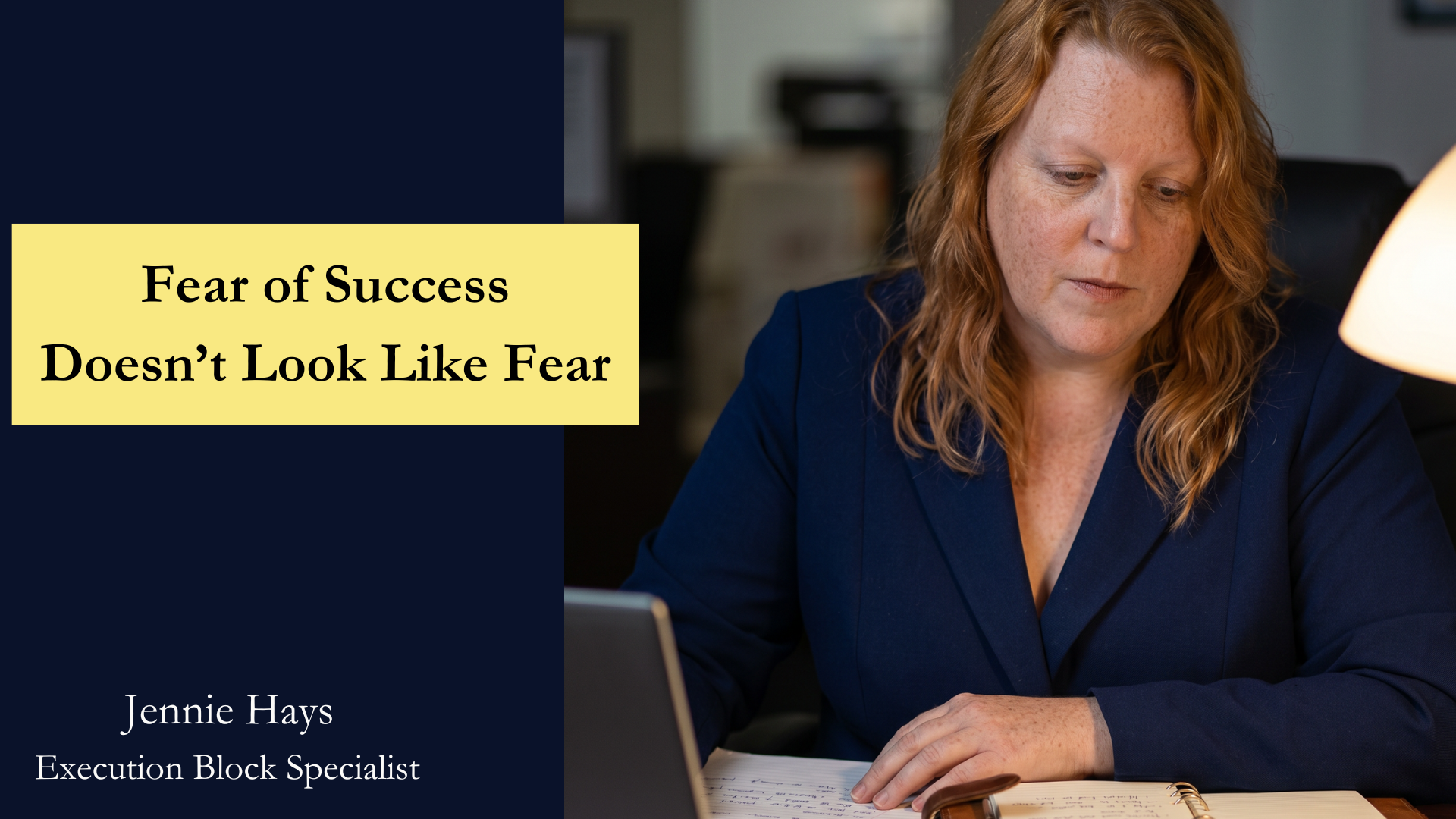
Fear of success doesn't announce itself as fear. It announces itself as balance. Sustainability. A smart decision to protect what you've finally built.
By the time most entrepreneurs recognize it, it's been running for months. Sometimes years.
That's not an accident. It's by design. The block uses the language you were taught to admire, which makes it the hardest pattern to catch and the most expensive one to miss.
What does fear of success actually look like in a business?
Not terror. Not even obvious hesitation. Nothing that registers as fear in the moment.
It looks like this.
The launch you haven't announced.
You built most of it. The offer is done, the sales page exists, the checkout link works. Some people already know it's coming. But somehow the launch email still hasn't gone out. Every time you sit down to send it, there's a reason this isn't the right week. The economy. A quiet season. The messaging needs one more pass. You want to feel more prepared.
There's always a reason.
The offer that's been 90% done for nine months.
You have the next thing. The course, the package, the group program. Every week you tell yourself you'll finish it next week. Every week something more urgent comes up. The urgent thing is almost always servicing the clients you already have at the rate you already charge.
The file staying closed is not an accident. It's protection.
"I'm just maintaining right now." This one hides the longest. You're calling it balance. Sustainability. Pacing. Protecting your energy. The voice underneath sounds responsible. "I've worked hard for this. I should let myself enjoy it. There's no rush."
And again, intentional rest is not the problem. The problem is when the business stops moving forward while you call the freeze wisdom.
Why does fear of success show up after the business starts working?
Because that's when there's finally something worth protecting.
After years of inconsistency, after the months where revenue dipped, after the seasons where you weren't sure you could pay yourself, your system finally found a state it could rest in. The bills are getting paid. You're doing what you need to do.
And now your brain wants to defend that state from anything that could disturb it. Including growth.
The block isn't afraid of growth itself. It's afraid of disturbing the only condition your system has verified as safe.
So it edits your decisions quietly. Reasonably. Using language that sounds like you. And your brain prioritizes protection over accuracy. It will generate convincing justifications if it believes those justifications keep you safe.
That's why people can logically explain their decisions while something underneath still feels slightly off.
What makes fear of success different from the other patterns?
Overwhelm is obvious. Perfectionism is recognizable. Imposter syndrome at least feels uncomfortable.
Fear of success feels correct.
That's the distinction that matters. The other patterns create friction you can feel. Fear of success creates logic you believe.
The entrepreneur who is overwhelmed knows something is wrong. The one running fear of success has a very sensible explanation for why she hasn't moved. She's protecting what she built. She's being strategic. She's not rushing into the next thing before she's consolidated the last one.
Those things can all be true. They can also be the block doing its job.
What does fear of success actually cost over time?
Businesses aren't static. If visibility decreases, if innovation slows, if you stop creating — the business does not stay exactly where it is forever.
Six months from now: some clients naturally finish. Referrals naturally slow. Visibility drops. Momentum gets thinner. The stable thing you were protecting starts eroding anyway.
That's the block running exactly as designed.
Here's what this looks like in practice. A client, I'll call her Brianna, came to me after her best month ever. Full roster. Clients she genuinely liked. A rate she could live on. Actual stability. But she'd done the math and realized her pricing wasn't sustainable long term. She needed to raise her rates.
She already knew the number. The email was drafted.
On our call she said, almost apologetically: "This is finally working, and I'm scared to touch it."
So I asked her what she was actually protecting.
"The clients I already have."
Then we did the math. Factually. Keeping one client at the old rate was worth about $1,500 a month. The full roster at the new rate was worth roughly $4,000 more per month.
Then she got quiet.
Because the real issue had become obvious. She wasn't afraid the math didn't work. She was afraid it worked too well. If she sent the email and it worked, she'd have proof she could have done it months earlier. And her brain didn't want that reality updated.
She sent the email two days later. Zero clients left.
Today, she signed two new clients. At a rate higher than the one she was afraid to charge.
The thing she was protecting was already outdated.
How do you know if this is a block or just a legitimate season?
There's a meaningful difference between intentional rest and the business being frozen in place while you call it something else.
Intentional rest still moves. Planning still happens. Relationships still build. Seeds get planted. There's forward momentum even when the pace slows.
Frozen looks different. Visibility decreasing. Innovation stopped. The same thing that wasn't moving last quarter still not moving this quarter, with an increasingly convincing explanation for why that's actually strategic.
Discomfort around growth and a running block are not the same thing. Discomfort can exist even after a block has been cleared. Normal friction around the next level doesn't mean something is wrong. The difference is whether the discomfort stops execution.
If awareness moves things, the friction may have been situational.
If the pattern is still running after you've already named it, understood it, and built a strategy around it. That points somewhere else.
The block is removable. That's a category distinction, not a promise. A skill gap requires building. A block requires removing. Different problems, different work.
Frequently asked questions
Is fear of success the same as self-sabotage?
They overlap, but they're not identical. Self-sabotage tends to interrupt progress that's already happening. You get close to something, and something derails it. Fear of success is more specific: it runs after the business is already working and protects stability from the next level of growth. Both are execution blocks. Both are removable. The distinction matters for identifying exactly what's running.
How do I know if I'm legitimately slowing down versus running fear of success?
Intentional rest still moves. Planning still happens. Relationships still build. If slowing down feels like a genuine break with forward momentum underneath it, that's probably real. If the business has been frozen in the same place for months while you generate increasingly good reasons for why now isn't the right time, that's the pattern worth looking at.
Why does fear of success feel so rational?
Because the block uses language you already trust. Balance. Sustainability. Being strategic. These are concepts you've been taught to value. The block doesn't generate obvious fear. It generates reasonable justifications built from things you actually believe. That's what makes it hard to catch without looking specifically for it.
Can fear of success be removed?
Yes. It's a block, not a personality trait or a permanent condition. The reason it persists isn't that it's unfixable. It's that most approaches treat it as a knowledge or awareness problem rather than a block. Information alone doesn't remove a block. That's not a personal failure. It's the wrong tool for the problem.
Suggested Reading in This Series
Fear of Success is often a creative mix of blocks getting in your way. Here are a few blogs that may be helpful for you to identify what’s got you stuck.
Is Imposter Syndrome Costing You Clients? Why It's Not a Confidence Problem
Is Perfectionism Costing You Revenue? Why It's Not About High Standards
About Jennie Hays | Execution Block Specialist

Jennie Hays is an Execution Block Specialist who works with entrepreneurs stalled at their next level. Her clients don't lack strategy. They're blocked from executing it and that gap has a measurable dollar cost.
Through Rapid Block Resolution, Jennie identifies the specific internal interference slowing execution, removes the friction attached to it, and restores consistent forward movement. She solves the right problem first and builds independence, not dependency.
Because once the block is resolved, execution becomes natural.
Learn more at jenniehays.com