Why Procrastination Is Not Always a Productivity Problem: Coach Client Connection
Sometimes procrastination is a planning problem. Sometimes the task is too vague, the setup is wrong, or you have not broken the work into small enough pieces to execute.
And sometimes you know exactly what needs to happen and still keep finding reasons not to do it.
I joined Stephanie O’Brien on Coach Client Connection to talk about Brainspotting, limiting beliefs, perfectionism, visibility and the business patterns that can make a ten-minute task take months or even years.
The conversation predates my current SCAN framework, but it contains an early version of a distinction that is central to my work now: before assuming you have a deeper block, figure out whether the problem is actually strategy, clarity, structure or execution.
When Procrastination Is Telling You Something
Stephanie and I talked about the way business tasks can get delayed even when they are objectively simple.
You know you need to make the video. But first your hair has to be right, your lighting has to be right and you need to know exactly what to say.
Or maybe you cannot decide which video to make, so the decision itself becomes the thing that stalls execution.
From the outside, it can all look like procrastination. But “procrastination” is a description, not a diagnosis.
Perfectionism Can Look Surprisingly Productive
One example from the conversation involved a client who had spent two years trying to finish a directory listing.
The task was essentially three paragraphs.
But she kept reworking and reformatting it because it had to be right before it could go live.
Once she had permission to publish it imperfectly and adjust it later, the listing went up that day.
“We hide in perfection.”
That does not mean the solution to every perfectionism problem is simply “publish bad work.” Sometimes it is. Sometimes there is still a deeper reason the person cannot tolerate putting unfinished or imperfect work where someone else can see it.
Sometimes the Fix Is Practical
One of my favorite parts of this conversation is that we did not treat every delay as something that needed Brainspotting.
Stephanie described struggling to record videos because the prerequisite pieces were not ready: deciding what to say, fixing the lighting, setting up the room and preparing herself to record.
Her solution was practical. Put those prerequisite tasks on the calendar separately.
I also talked about using AI to break large, vague tasks into the smallest useful next action.
“Redo your website” is not particularly executable.
“Open the page and copy the existing text into a document” is.
That distinction matters. A vague task does not automatically mean you have an execution block.
When the Same Specific Action Keeps Stopping
The more interesting pattern is when the person already knows how to begin, understands the task and still repeatedly stops at the same point.
I gave the example of my own website. I regularly helped other people get their websites online, yet it took me 18 months to finish mine.
Eventually I realized the practical problem was not that I did not know how to build a website.
Putting it online meant people could see me.
Once I identified that, I was able to move.
Sometimes identifying the actual issue is enough. Sometimes it is not.
Where Brainspotting Fits
Much of the episode focuses on Brainspotting and how I use it with patterns that do not shift through ordinary strategy or mindset work alone.
Brainspotting is not something I use for every annoying task I would rather avoid.
In fact, later in the conversation I explained that experience has made it easier to distinguish among three different situations:
- I simply do not know how to get started.
- I need a practical support such as body doubling or a clearer structure.
- There appears to be a persistent block worth addressing more directly.
That distinction is even more central to my work today.
In This Episode We Discuss
- Brainspotting and how Jennie uses it in her work
- Limiting beliefs and old experiences that influence business behavior
- Why procrastination is not always laziness
- Perfectionism and visibility
- Why important tasks can trigger more avoidance than unimportant ones
- Publishing imperfect work and learning from the result
- Breaking large tasks into executable steps
- Using AI to clarify the next action
- Body doubling and other practical execution supports
- How to tell when a problem may need more than another productivity strategy
Watch the Full Episode
Watch my full conversation with Stephanie O’Brien on Coach Client Connection.
Coach Client Connection Episode Transcript
Prefer to read the conversation? The full transcript is available below. It has been lightly cleaned for readability, punctuation and obvious transcription errors while preserving the substance and conversational language of the original episode.
Read the full episode transcript
0:00 Stephanie O’Brien: Hey everyone, this is Stephanie O’Brien at Coach Client Connection, and today I'm joined by Jennie Hays. We're going to be talking about how trauma can really slow down your business, your life, can derail it, can cause you to self-sabotage and can make so many things that could have been easy so much harder.
Jennie is going to be sharing about a modality that can help you to heal and recover a lot faster than you otherwise would have, so you can hit the ground running, build your business and life at full speed and have the same amount of effort get much better results.
Thank you very much for joining me, Jennie.
0:34 Jennie Hays: Hi, Stephanie. I'm so happy to be here, and I love talking about this, so this should be fun.
0:40 Stephanie: I'd love to learn more about Brainspotting and share some more of it with the audience. How is Brainspotting different from all these other trauma-healing modalities they've probably heard about?
0:49 Jennie: One of the really cool things that's been happening in the last 20 years or so is that we are getting more trauma-healing modalities.
A lot of it started from veterans, where they were like, “What do we do with these people that are coming back and they're broken inside, it feels like?”
They tried things like exposure therapy, which was really hard on them because they would have to relive traumas over and over again.
Then they started to introduce what we call somatic techniques, which are mind-body. We're finding that when we involve the body and not just the mind, we're making leaps and bounds, and Brainspotting is one of the newer somatic modalities.
They're using a technique called EMDR right now, which they consider the gold standard for trauma. It works by moving your eyes a specific way, and Brainspotting takes that idea in a different direction.
We used to use the word trauma mostly for those big things. You were in a horrible wreck and now you can't drive. You were overseas in the war and now every time a car backfires, you hit the ground.
What we're learning as we're developing all these techniques is that trauma can also involve smaller experiences that take on a much bigger meaning for the person.
Maybe when I was a kid, my dad told my mom that you have to work hard for money and I overheard it. Now I think I can't make money because I have to work hard for it, so I can't charge for it.
For me personally, I was about 11 years old, sitting in the back seat of our car and singing with the radio at the top of my lungs.
My dad said, “We don't need a concert in here.”
To me it meant, “Shut your mouth. You're not there to be heard. Be quiet.” And this was a little girl who wanted to be a singer.
Those are the experiences that I really love going in and completing, especially when they're affecting our business.
3:16 Stephanie: I think that's a really good point. So many things, whether you call them problems or limiting beliefs, shape our identities, our perception of which parts of us are wanted, what it takes to succeed and what success even looks like.
A lot of this is shaped by those little incidents that you may or may not even consciously remember. Kids are in such rapid learning mode and don't have the filters adults do.
We get a piece of feedback and run with it way farther than the person giving it ever intended.
3:49 Jennie: Yeah. When I mentioned that story to my dad many years later, he was like, “I don't even remember that.”
And it's like, that's a pivotal piece of my childhood.
There are a lot of these little things that happen and we don't have a memory to go with it, but they become that limiting belief. “I can't be seen. I'm not good enough. I need this. I should be doing this.”
“Should” is a big one. Shoulding all over yourself.
It's those things where we know we want to do something and just can't do it because of the “ugh” factor.
I spent so many years there myself, which is why when I found Brainspotting, it was like, what the heck?
I spent five years spinning in circles from limiting beliefs and old little traumas that I had no idea about, blaming everything else in the world. And it took one hour to change my world.
5:24 Stephanie: In the movie Inside Out, there's this moment where she accidentally dumps two boxes and says all these beliefs, facts and opinions look so much alike.
How do people identify what is a limiting belief or a story you're telling yourself versus what's just plain fact?
5:48 Jennie: The amazing thing is that the body and the brain do that for me. I don't have to do that.
People come in with all those balls mixed up, and we don't even think they're mixed up.
Our brain can intentionally mix those things up in an attempt to protect us. Its job is to keep you alive. It will lie to you all day long to do that. But your body gives you information too.
I often tell people that there may be a limiting belief or underlying issue worth looking at when you're going to do something and your body just shuts down and says, “I'm not doing it.”
6:46 Jennie: In Brainspotting, we allow the body and brain to work together in a new way. I do 99% of it virtually, and the person on the other side of the screen begins to put those pieces together.
7:12 Stephanie: If somebody is carrying some of these traumas but doesn't realize it, what are some of the ways people can tell they're carrying traumas or false beliefs they need to get rid of in order to truly live freely and have the success they need?
7:31 Jennie: I like to identify those as blocks, especially in the business world.
When you know you need to do something, marketing is a big one. “I know I need to make that video, but I procrastinate. I'll do it tomorrow. I'll do it next Friday.”
Or everything needs to be perfect. My hair has to be perfect. My makeup, everything needs to be perfect.
I go so far into editing everything that it takes me three months to do one video, so I just don't do it because it takes too long.
Or the thought of it scares me so much that it's like, “You want me to do what?”
Maybe you're like, “I can't even decide what video to make. Should I do this, this, this, this or this?”
Basically, I pay attention to anything that delays what you're doing.
I identified a block in myself once and didn't need to Brainspot it. I just had to identify it.
I work with people all the time getting their website up. It took me 18 months to do mine.
It was, “I'll do it tomorrow. I'll do it next week. I'll do it later.”
Then one day I was sitting there thinking, “Why haven't I done this?”
I realized I kept putting it off because once I put it out there, people were going to see who I am.
And I was like, people see who I am anyway. Get over it and do it.
If you can do that, beautiful. But you can't do that for everything.
9:37 Stephanie: That reminds me of an article I read, I think it was titled, “There's No Such Thing as Laziness.”
You see posts saying, “If you haven't done it yet, you don't care enough about it.”
No. People can procrastinate more on the things that really matter to them because there are stakes.
They're afraid of failing, not doing it right or getting overwhelmed.
9:59 Jennie: Yeah, because their brain is saying, “If you don't do it, there's no risk of failure.”
“If I can keep you busy, distracted or in the I-don't-knows, then we'll never get hurt.”
10:36 Stephanie: Or there are times you might be tempted to put a half effort in so you have that defense mechanism: “That wasn't my real effort they were rejecting.”
We can't put 100% into every single thing. There aren't enough hours in the day. You don't have to pore over every little thing to make it perfect.
But there's also going too far into, “I'm just going to half-ass this so I don't have to feel like my real effort was rejected.”
11:07 Jennie: But let me tell you something wonderful for those people who are like, “Half-ass is the best I can do right now.”
In the age of AI, what we're finding in marketing is that the messy hair, getting out of the shower with the robe on, your makeup not done, the person who says “um” and stumbles over their words, people are attracted to that because there's so much out there that is perfect.
We need your imperfection to know that you're human.
But like you said, you can go the opposite way of, “Let me just throw something up there.”
I'm kind of a fan of throwing something up there because the more you do that, the less it bothers you, and the more your brain goes, “Oh, nobody said anything about that. Nobody was rude. Nobody was mean. I can do that again.”
It can allow you to move forward.
12:03 Stephanie: So I guess people need to check in with themselves. Am I not pursuing perfection because I think my imperfection is good enough, or because I fear my perfection won't be good enough?
12:16 Jennie: What I find with people who are afraid to do it because their perfection isn't good enough is that they're just not doing it, or they're doing it but never getting it finalized.
I had a client who worked with another coach for two years and all she was trying to do was get a directory listing.
We're talking about three paragraphs.
But she couldn't do it. She kept trying to reformat it and redo all these things.
We worked together and she had that directory listing up that day because she was putting it off because it had to be perfect.
She was hiding in perfection.
That's an extreme case, but that's the reality. We hide in perfection.
When we did the work and she had permission to put it up raw and know she could fix it, touch it as many times as she wanted to as long as it was up there, it was like, “Oh, I can do this.”
13:35 Stephanie: I think it can also be good to put out imperfect things just for the experience of, “It wasn't flawless and nothing blew up.”
The first time I hosted a three-day challenge, part of my script on my slides said, “Say this in the chat.”
Well, I couldn't check the chat. The whole Zoom interface disappeared.
I spent the whole first day not knowing where the chat was. Halfway through the second day, I found out I had two monitors and one was off. Zoom had put the entire interface on the monitor that was off.
I'd been honest through the process and said, “Guys, the whole interface is gone. I don't know why. Zoom's never done this before, but I'm going to do my best for you anyway.”
People were supportive. When I finally found the stupid missing thing, there was a little celebration. It was our shared victory.
14:34 Jennie: Yes, because you were real. You were who you really are and you weren't afraid of it.
My very first challenge I ran, I had to invite friends because nobody showed up.
And I'm honest about that because it was like, you know what, I still did it. I still showed up. I did the thing.
The next time I had five people show up, then eight people, and it continued to grow until I switched niches.
As long as I was doing the thing, people responded.
You've got to do the thing, and that's where people get stuck.
15:19 Stephanie: If somebody wanted to learn more about Brainspotting, explore whether it's something they wanted to have done for themselves, or something they wanted to learn and add to their own practice, what would their first steps be?
15:30 Jennie: I'd love to talk to them about it. I'm not a salesy kind of person.
I'm a “let's talk and see if you need Brainspotting or if you want to learn” person. I'm happy to share my sources where I learned it.
It's an amazing tool.
If you want to learn how to do it, let's talk and I'll share my sources. If you want to have it done, let's talk and see whether it makes sense.
I spent five years struggling. I can't say I wasted those years because I learned a lot during that time, but it could have been easier.
16:42 Stephanie: The amount of effort we can spend struggling to do something that could have been easy, or the time we spend procrastinating on a task that takes ten minutes. How many of us have done that?
16:51 Jennie: I know. I know.
But I don't Brainspot every little task because that would be ridiculous.
Because I've done so much Brainspotting now, between my training and working with other people, when procrastination starts to come up I can identify: Is this just something I need to know how to get started on?
Is it something that I need my husband to body double with me on?
Or do I really need to go and get this Brainspotted?
17:27 Stephanie: One other tip I find useful for procrastination is to put the prerequisite tasks in the calendar.
I was having an issue with videos. I'd go to do a video, but I didn't know what I was going to talk about or didn't have the right lighting or environment.
So I put those prerequisite tasks as separate tasks beforehand.
“In this time window, I will figure out what I'm going to say. I'm going to fix my hair. I'm going to clean up the room.”
Those things would otherwise eat up the time I intended to spend recording.
17:55 Jennie: Yes. Very smart. Breaking things down into the smallest possible step.
Side tip: ChatGPT can help you do that.
For any AI heads out there like myself, you can set up a project that's a personal assistant and tell it what your top goals are, your appointments and how long things take.
Then when you say, “What's next?” it gives you the next small step.
So it doesn't say, “Redo your webpage.” It says, “Pull up your webpage and copy it into Word so you can start tweaking it.”
18:43 Stephanie: Breaking it down like that is so important. If it's just “work on your website,” that's this huge amorphous blob of work.
If you break it down into steps, even breaking it down into steps can be another item you put in your calendar as its own separate task.
Step one: break the rest down into steps.
19:00 Jennie: Yeah. I'm not good about that piece, which is why I like relying on AI to do it.
I've been using ChatGPT since very early on, so I'm very good friends with Chat.
[Laughter]
19:21 Stephanie: That's probably another thing you could teach people if they want to talk to you.
19:23 Jennie: The simple ways to use it for business. Oh my gosh, yes. If they want to come play with that, I love sharing that too.
19:30 Stephanie: If you want to talk with Jennie about ChatGPT, Brainspotting or any of this, the contact info is going to be in the show notes.
Whether you're watching on YouTube, on my blog or social media, it'll be with the post.
19:49 Jennie: And if you come over to my site, you'll see a nice blog that'll bring you right back to Stephanie's stuff because that's how we help each other grow, right? We promote each other.
20:00 Stephanie: Absolutely. We're coming close to the end of our time together. Any final thoughts or especially juicy tips you want to share?
20:10 Jennie: Something you can use going forward is, when something happens, especially if it's overwhelming in the moment, if you can, feel the feelings.
We're taught to push those feelings down and ignore them.
If you can't feel them in the moment, make yourself five or ten minutes later in the day when you're by yourself and feel the feelings.
If you go on stage and it sucks, if you don't want to be terrified next time you go on stage, give yourself a few minutes. Feel it. Cry it. Scream it out, whatever. Allow yourself to process the emotion.
21:19 Stephanie: That is a fantastic tip. I like to compare emotions to messengers, and they are very insistent messengers.
If you don't let them in the front door, they will put on a disguise and come in the back door. The message will be more garbled and you'll have a harder time parsing it, but they will communicate it.
21:34 Jennie: They will, and they can stop you in your tracks. They can keep you from success.
21:40 Stephanie: Thank you so much for all the amazing tips you shared.
Those of you watching, I hope you'll take some time to contact Jennie and get in touch with her. Learn about AI or Brainspotting, whichever is most necessary for you.
Learn how to get past that frustrating procrastination that makes you take two or three years to do something that could have taken ten minutes.
Thank you again for joining me, Jennie, and thank you to everyone else who joined. I hope you all have an amazing day.
About Jennie Hays
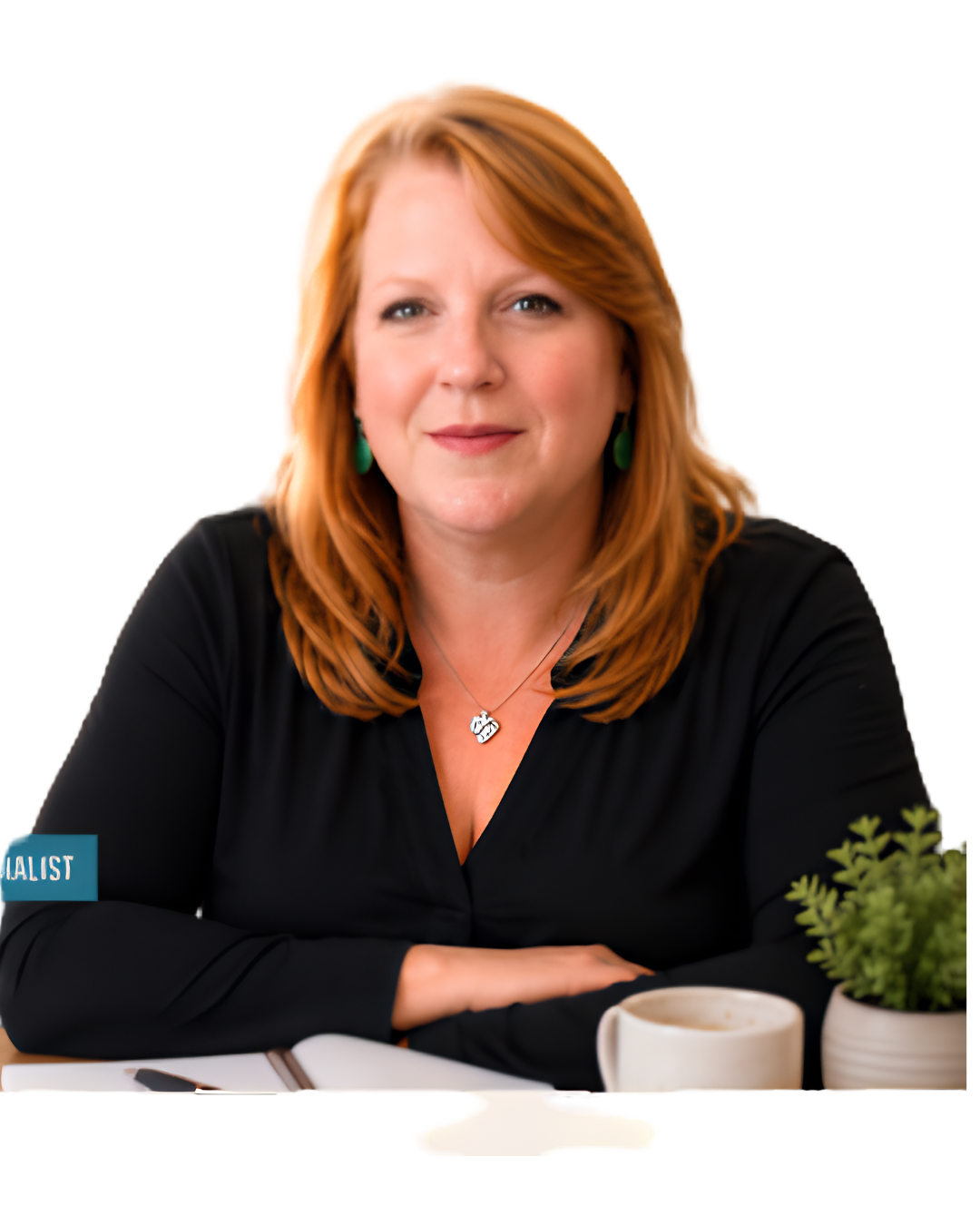
Jennie Hays is an Execution Block Specialist, Brainspotting Practitioner and business coach for coaches, consultants and service-based entrepreneurs.
She helps capable people figure out why strategies they already understand are not consistently turning into action.
Her work distinguishes between a true execution block, a strategy that does not fit the person and a plan that is simply too vague or poorly structured to execute.
When an actual execution block is present, Jennie combines rapid block resolution and Brainspotting with practical business strategy and execution design to help clients return to clear, measurable action.