
Journaling to Manage Election Stress
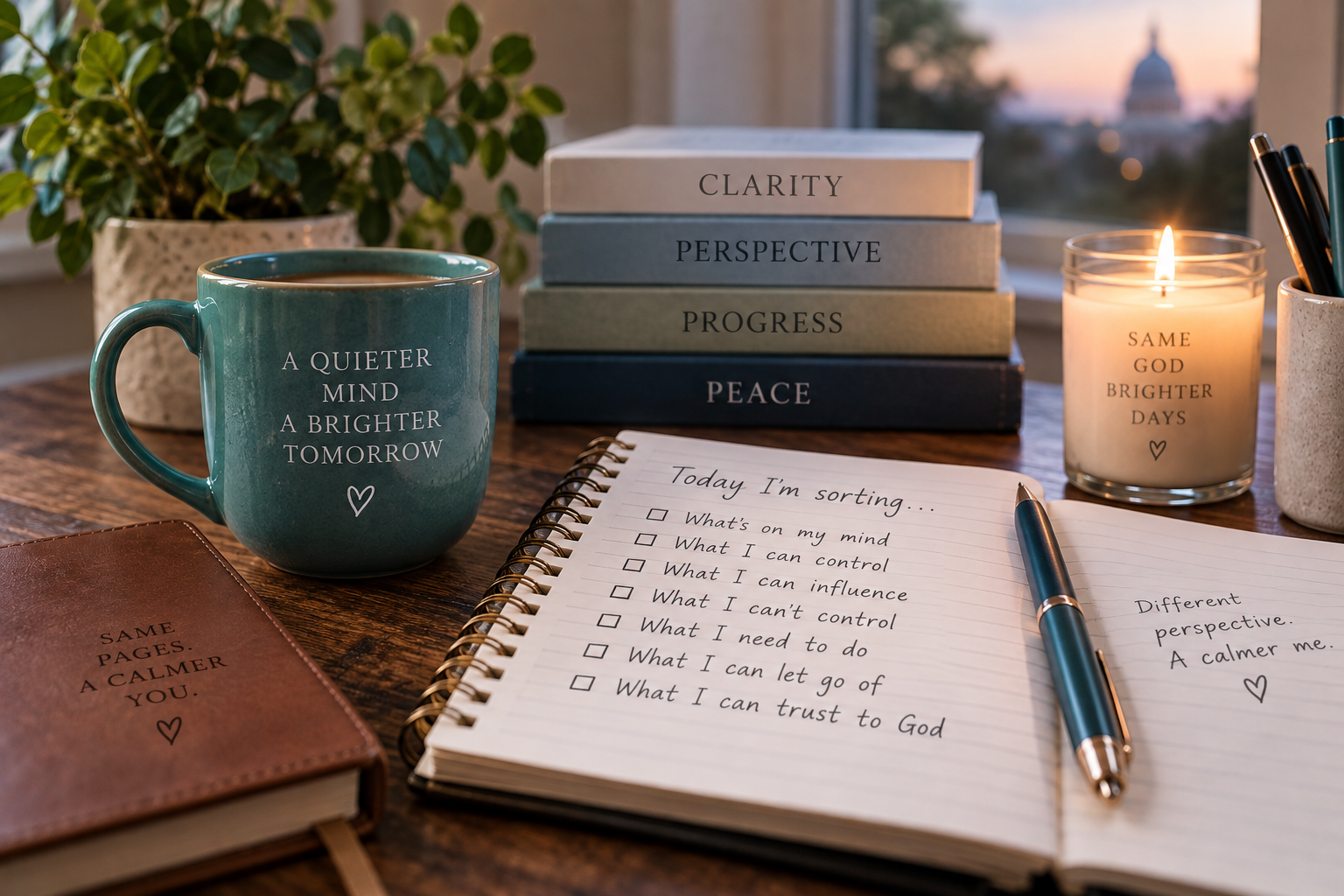
When election stress is bouncing around in your head, everything can start feeling equally urgent.
The thing that actually happened. The thing somebody predicted might happen. The argument you had yesterday. The headline you read this morning. The decision a leader could make six months from now. The action you genuinely need to take.
They can all end up in one mental pile labeled THIS IS A PROBLEM.
That is where journaling can be useful.
Not because writing something down magically makes it disappear. Journaling gives you a place to get the thoughts out where you can actually look at them, separate them, and decide what deserves action, what needs more information, what you can influence, and what you are trying to mentally control despite having no control over it.
The goal is not to produce beautiful journal pages. The goal is clarity.
Key Points
- Use journaling to sort election stress rather than simply recording the same worries repeatedly.
- Separate what you can control from what you can influence and what is genuinely outside your control.
- Turn actionable concerns into specific next actions instead of continuing to think about them.
- Use gratitude to widen your attention, not to convince yourself that legitimate concerns do not matter.
- If writing reveals one highly specific thought, image, conversation, or physical response that remains strongly activated, that may call for a different tool than more journaling.
Journaling Is Most Useful When It Produces Information
There is nothing wrong with opening a notebook and writing everything you feel.
Sometimes that is exactly what you need.
But there is also a version of journaling where you write the same worry for 20 minutes, close the notebook, and continue worrying about exactly the same thing.
You have documented the stress beautifully. You have not necessarily done anything with it.
I want to use journaling differently.
Get it out of your head, then sort it
What exactly am I concerned about?
Is there anything I can actually do about it?
Do I need more information, or am I repeatedly consuming information because uncertainty is uncomfortable?
What is mine to act on, and what am I trying to mentally control?
Those questions turn the journal into a decision tool rather than an archive of anxiety.
Choose the Exercise That Matches the Problem
Your thoughts feel crowded
Start with free-writing or a “What's on my mind?” list. Get the mental pile onto paper before trying to organize it.
You feel powerless
Use the control, influence, and cannot-control exercise to identify where your effort can actually go.
You keep predicting outcomes
Use targeted prompts to separate what is known, what is possible, and what your mind is repeatedly rehearsing.
You cannot stop checking
Journal the checking pattern briefly, then address the digital behavior. This may be an exposure problem more than a writing problem.
1. Start With a Five-Minute Brain Dump
Write before you organize
Set a timer for about five minutes and write whatever is taking up space in your head.
Do not edit. Do not make it sound reasonable. Do not worry about grammar. Nobody is grading this, and your journal does not need a content strategy.
You might write about:
- something you read,
- a conversation that bothered you,
- a possible future outcome,
- anger or frustration,
- something you feel compelled to keep checking,
- a decision you think you need to make, or
- something completely unrelated that is competing for the same mental space.
When the timer ends, stop.
You do not have to immediately analyze every sentence. First notice whether getting it onto paper changed anything about the sense of mental crowding.
2. Ask “What's Actually on My Mind?”
Turn the mental pile into individual items
Write “What's on my mind?” at the top of the page.
Then list each concern separately.
For example:
- I'm worried about a particular policy change.
- I keep thinking about the conversation I had with a family member.
- I'm checking the news too often.
- I don't know whether something I read is actually accurate.
- I'm frustrated that I cannot control what happens next.
Now you have five different things instead of one giant feeling called election stress.
That matters because those five things may need five different responses.
3. Sort It Into Control, Influence, and Neither
The traditional journaling exercise uses two columns: what I can control and what I cannot control.
I prefer three.
There is a meaningful middle category between controlling something and having absolutely no influence over it.
What I Can Control
Your actions, boundaries, media consumption, whether you vote, whether you contact an elected official, how you speak to people, and what you choose to do next.
What I Can Influence
You may be able to advocate, volunteer, donate, communicate, participate locally, have conversations, or support people affected by an issue without controlling the final outcome.
What I Cannot Control
Other people's votes, another person's opinion, every future decision made by a leader, the entire news cycle, and outcomes that have not happened yet.
What Needs More Information
Some worries do not belong in any column yet because you do not actually know whether the premise is true. Mark those for intentional research instead of endless speculation.
Now look at the first two categories.
Is there an action you actually want to take?
If yes, write the action.
Make it specific enough that you would know whether you did it.
“Be more involved” is vague.
“Read the actual text of the proposal tomorrow” is an action.
“Contact my representative” is an action.
“Stop checking this story until there is actually new information” is also an action.
Once you have identified the action, you do not need to keep solving it in your head. Put the action where you will actually see it and move on.
4. Separate What You Know From What You Are Predicting
Do not let possibility quietly become certainty
Election stress can involve legitimate concerns about what may happen next. But when you are worried, possibilities can start feeling like established facts.
Try dividing a page into three sections:
- What I know
- What I think may happen
- What I would do if it happens
This is not about convincing yourself that your concern is unfounded. It is about being accurate about which part is current reality and which part is prediction.
Then look at the third section.
If the thing you are concerned about happened, would there actually be something you could do?
If yes, you have identified a possible future action. You probably do not need to rehearse it another 47 times tonight.
If no action exists right now, repeatedly thinking about the possibility is not secretly turning into preparation.
Ask whether you are solving or rehearsing
Am I learning something new?
Am I making a decision?
Am I identifying an action?
Or am I running the same possible future through my mind again because uncertainty feels unfinished?
5. Use Better Prompts
Journaling prompts are useful when they lead somewhere.
“How do I want to feel?” can be interesting, but if you are trying to sort election stress, I would ask questions that give you more actionable information.
Prompts that help you identify the actual problem
You do not need to answer all of those every time you journal. Choose the one that fits the problem you are actually having.
6. Use Gratitude to Widen the Frame
Notice what else is also true
Gratitude journaling can become irritating very quickly if it is used to tell someone that a legitimate concern should not bother them because they have nice things in their life.
That is not the job.
The job is to widen your attention.
Write down one to three things that were genuinely good, meaningful, useful, funny, beautiful, or comforting today.
Be specific.
Instead of:
you might write:
Or:
Or simply:
The point is not that election concerns disappeared.
The point is that election concerns are not the only thing that happened today.
7. Do Not Just “Let Go.” Decide What Happens to the Concern.
The phrase let it go sounds lovely until your brain responds, “Excellent suggestion. How?”
Instead of writing a list of worries and ordering yourself to release them, give each concern a destination.
It becomes an action
There is something concrete you can do, so write the next step and decide when you will do it.
It becomes a research question
You need reliable information before deciding what you think or what action makes sense. Write the question instead of continuing to speculate.
It becomes a boundary
The problem is repeated exposure, checking, or an unproductive conversation. Change the input or interaction.
It becomes something you cannot resolve today
There is no meaningful action available right now. Acknowledge that instead of disguising continued worry as problem-solving.
For Me, Some of That Last Category Becomes Prayer
Writing can help separate responsibility from control
I am Christian, so when journaling makes it clear that I have reached the edge of what I can actually do, prayer is one place those concerns can go.
That does not mean I write “give it to God” beside something that genuinely requires action from me and call the work finished.
Sometimes the journal makes it obvious that I need to do something.
Sometimes it makes it equally obvious that I have already done what is mine to do and am continuing to mentally work on something I cannot control.
Those are different situations.
A useful prompt for me is:
That question can turn journaling into a natural transition into prayer rather than another hour of analyzing the same uncertainty.
If you are using journaling in the evening, the Nightly Meditation or Prayer Routine to Ease Election Stress gives you a way to close the day after the writing is finished.
8. If Your Journal Reveals a Digital Problem, Fix the Digital Problem
Do not journal around a behavior you can change
Suppose your journal contains some version of this every day:
At some point, the journal has done its job.
You have identified the pattern.
Now change the pattern.
Turn off the notification. Move the news check. Stop opening the comment section. Put a boundary around the evening.
You do not need three more weeks of self-awareness about a behavior you already understand.
If repeated digital exposure is the pattern you uncover, use Manage Election Stress with a Simple Digital Detox to build the practical boundary.
What If Writing Makes You More Worked Up?
That can happen.
Journaling is not automatically helpful simply because it involves a notebook.
If you notice that you are repeatedly writing the same arguments, predictions, or fears and becoming more activated as you go, stop.
You do not get bonus points for filling another page.
Ask:
If the answer is no, choose a different tool.
You might need to step away from the subject entirely for a while. You might need movement, grounding, prayer, a conversation, a digital boundary, or simply something else to do.
And sometimes the writing reveals something much more specific.
When Journaling Identifies a Specific Activated Response
You may start with a page full of general election stress and discover that one particular thing carries most of the intensity.
Maybe it is one conversation.
One headline.
One image.
One possible outcome.
One physical response that appears every time you think about a particular issue.
That is useful information.
At that point, more journaling may or may not be what you need.
If you want a self-directed technique for working with a specific activated target, EFT Tapping for Election Stress gives you a structured way to test how that response changes.
If the response keeps returning despite reasonable practical changes and self-directed tools, working with the response more directly may make more sense than continuing to analyze it.
Where Brainspotting Fits
Brainspotting is a brain-body based processing modality developed by David Grand. It uses eye position and focused attention as part of the processing work.
I consider Brainspotting when there is a clearly defined response that continues to carry emotional or physical activation after the obvious practical pieces have been addressed.
The journal can actually help identify that target.
You may discover that your concern is not “the election” in general. It is what happens in you every time you encounter one specific topic, possibility, memory, conversation, or image.
The goal of Brainspotting is not to change your political beliefs, persuade you that your concern is irrational, or make you stop caring about something important to you.
The work is focused on the recurring response that is interfering with how you want to function.
I am a certified Brainspotting practitioner, not a therapist. I also bring approximately 25 years of paramic experience, including years in clinical emergency practice. That experience informs how I assess fit and scope and recognize when practitioner Brainspotting is appropriate versus when someone needs assessment or treatment from a licensed mental-health or healthcare professional.
You do not need to determine that before contacting me. I can screen for fit and scope and refer out when another type or level of care is more appropriate.
You Do Not Need to Journal Every Day
A journal is a tool, not another habit you have failed at if you miss Tuesday.
Use it when writing helps you externalize something that is difficult to sort while it is bouncing around in your head.
For some people, that may be a regular evening practice.
For others, journaling is most useful when something specific is taking up too much mental space.
The measure is not how many pages you produce.
The measure is whether the writing helps you see more clearly what you are dealing with and what, if anything, you need to do next.
The Point Is Not to Write More. It Is to See More Clearly.
Election stress can feel enormous when facts, predictions, responsibilities, fears, opinions, and possible futures are all competing for space in your head at once.
Journaling gives you somewhere to put them so you can stop treating them as one problem.
Write down what is actually bothering you. Separate what you know from what you are predicting. Identify what you can control, what you can influence, and what is outside your control. Turn actionable concerns into actual actions.
If you need information, identify the question you need answered instead of endlessly consuming information.
If the problem is repeated digital exposure, change the exposure.
If there is nothing left for you to do tonight, let the writing help you recognize that too.
For me, some of those concerns become prayer. I can ask God for wisdom about what is mine to do while acknowledging that I was never meant to control every possible outcome.
The journal does not have to solve the election, predict the future, or make you feel positive about everything. It only needs to help you see clearly enough to know what comes next.
Suggested Reading
Once journaling helps you identify what is actually creating the stress, these articles can help you choose the next tool that fits the problem.
A Nightly Meditation or Prayer Routine to Ease Election Stress
Use journaling as the first part of an evening transition, then move into meditation or Christian prayer when you are ready to stop analyzing the day and let it end.
EFT Tapping for Election Stress: A Step-by-Step Guide
Try EFT when your writing identifies a specific thought, conversation, possibility, or physical response that still feels strongly activated.
Manage Election Stress with a Simple Digital Detox
Build practical boundaries when your journal makes it clear that repeated news checks, notifications, social media, or online arguments are feeding the stress.
Once journaling helps you see what the real problem is, visit How to Deal With Election Anxiety: Election Stress Resources to choose practical support.